A Full extension ball bearing drawer slide allows a drawer to travel almost completely beyond the cabinet opening. This movement exposes the rear compartment, not just the front section. It is a practical choice for kitchen units, tool chests, office cabinets, and storage furniture.
The slide uses steel members and rows of hardened ball bearings. As the drawer opens, the bearings roll between the members and distribute the load. “Smooth travel begins with accurate alignment, not with the bearings alone,” explains Michael Turner, a drawer-hardware engineer with more than twenty years of installation experience. His point deserves attention. A high load rating cannot correct a twisted cabinet or uneven mounting.
A reliable Full extension ball bearing drawer slide should match the drawer width, length, clearance, and expected weight. Many models require about 12.7 millimeters of side clearance per side, but specifications differ. Measure carefully.
Small errors matter.
A slide may feel smooth when empty, then bind under a loaded drawer. This is where practical testing becomes important. Installers often open the drawer repeatedly, inspect the mounting screws, and check whether the front remains level. Soft-close and locking features can improve daily use, but they also add cost and adjustment requirements. The best choice is not always the heaviest slide. It should suit the cabinet material, drawer construction, and real working load. That balance forms the foundation for understanding how full-extension hardware performs in everyday furniture.
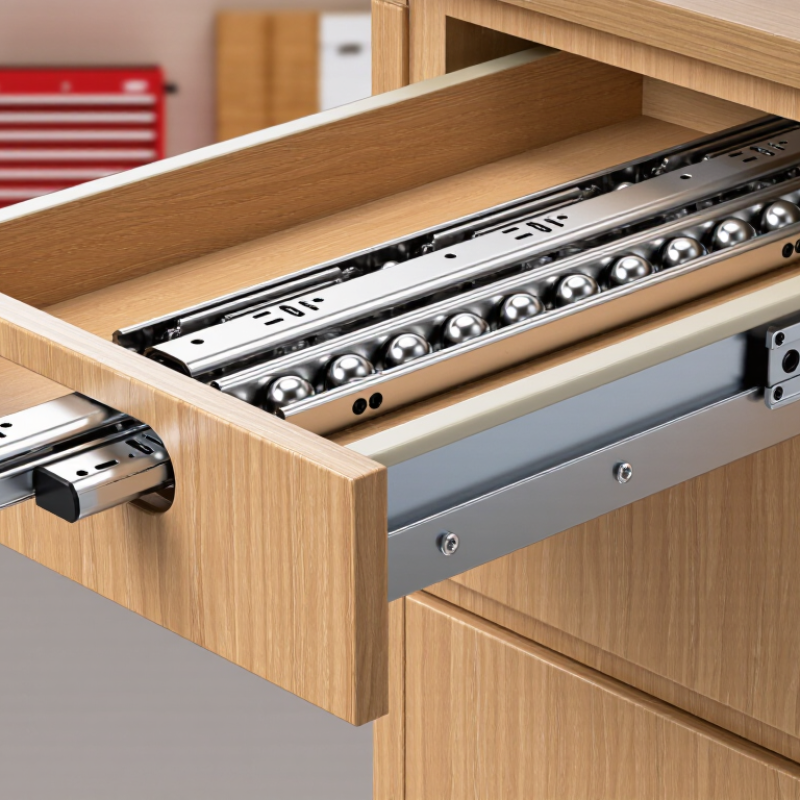
What Is a Full Extension Ball Bearing Drawer Slide?
A full extension ball bearing drawer slide lets a drawer travel completely beyond the cabinet opening. You can reach the back without leaning awkwardly or removing stored items. Small steel balls move between metal tracks, reducing friction during opening and closing. This design supports smooth movement and steady alignment when installed correctly.
In practical use, the slide needs accurate measurements. The drawer width, side clearance, and cabinet depth must match the slide specifications. Most side-mounted models require equal space on both sides. A drawer that feels tight may have uneven gaps, loose screws, or a slightly twisted cabinet. I have found that testing the slide before loading the drawer prevents many frustrating adjustments. Still, even careful installation can need minor correction.
Tips: Measure twice, and check the cabinet for square corners. Keep the tracks parallel from front to back. Use suitable screws that do not extend into the drawer interior. Open the drawer fully and inspect its movement. A soft, controlled motion usually indicates proper alignment. Avoid forcing a stiff slide. That can damage the bearings or bend the track. Load capacity also matters, especially for drawers holding tools, cookware, or dense hardware. The stated rating may assume ideal installation, which is easy to overlook. Clean the tracks occasionally with a dry cloth. Grease can attract dust and create rough movement.
How Does a Full Extension Ball Bearing Drawer Slide Work?
What Is a Full Extension Ball Bearing Drawer Slide?
How Does a Full Extension Ball Bearing Drawer Slide Work?
A full extension ball bearing drawer slide uses two or more steel rails and rows of small bearings. The bearings roll between the rails as the drawer opens. This movement reduces friction and keeps the drawer traveling smoothly. Unlike partial-extension hardware, it allows the drawer box to move almost completely beyond the cabinet. You can see the rear contents clearly.
In practical installation, the cabinet rail attaches to the side panel, while the matching rail connects to the drawer. When you pull the handle, the bearing cages distribute the load along the slide. This prevents sudden rubbing and supports controlled movement. A properly aligned slide should feel firm, not loose. Small errors matter. Uneven cabinet sides can cause scraping, noise, or difficult closing. I have found that a level check often solves problems that appear to involve the hardware itself. Still, load ratings can be misunderstood, especially with wide drawers and heavy contents.
Tips: Measure the drawer and cabinet opening carefully before installation. Keep both slides parallel and at the same height. Use the recommended screws, and avoid overtightening them. Test the drawer with light weight first, then add contents gradually. If the slide feels rough, inspect alignment before applying lubricant. Some slides are designed for specific loads, so never judge capacity by appearance alone.
What Are the Main Components and Specifications?
A full extension ball bearing drawer slide lets a drawer travel completely beyond the cabinet opening. This exposes the rear contents, not just the front half. Its main components include three steel members, hardened ball bearings, a ball retainer, stops, and mounting holes. The cabinet member stays fixed. The intermediate and drawer members move through the opening.
Specifications determine real performance. Load capacity commonly ranges from 35 to 100 kilograms, depending on slide length, installation, and testing method. A 500-millimeter slide needs a cabinet depth slightly above 500 millimeters. Side clearance is often about 12.7 millimeters per side. According to the 2024 Grand View Research furniture hardware analysis, demand is supported by modular storage and space-efficient furniture. That trend increases pressure on smooth, repeatable movement. ISO 281 also reminds engineers that bearing life depends on load, speed, lubrication, and contamination—not only advertised capacity. A 100-kilogram rating can mislead when the load sits unevenly.
Tips: Check the manufacturer’s test standard before comparing ratings. Measure both cabinet depth and side gaps. Look for corrosion-resistant steel in humid rooms. Cycle a sample drawer repeatedly. The motion should remain quiet and even. I have seen installations fail because screws entered too close to the raceway. Soft-close versions add springs or dampers, but they may reduce usable load and extension speed. Disconnect levers improve maintenance, although they can introduce extra play after repeated removal.
What Is a Full Extension Ball Bearing Drawer Slide?
A full extension ball bearing drawer slide is a telescopic hardware assembly that allows a drawer to travel outward until nearly its entire depth is accessible. The common construction uses three steel members, precision ball bearings, retainers, mounting holes, and a stop mechanism.
The chart shows common nominal slide lengths used for full-extension applications. For a correctly matched full-extension slide, the usable travel is approximately equal to the slide length, although the exact travel depends on the slide design and installation. A typical 45 mm side-mount slide requires about 12.7 mm of clearance on each side of the drawer.
Main members:
Outer member, middle member, and inner member
Rolling element:
Hardened steel ball bearings held in retainers
Typical clearance:
Approximately 12.7 mm per side for many 45 mm slides
Typical lengths:
Common nominal sizes range from 300 mm to 600 mm
How to Choose the Right Full Extension Drawer Slide
What Is a Full Extension Ball Bearing Drawer Slide?
A full extension ball bearing drawer slide lets a drawer travel beyond the cabinet opening. You can reach nearly the entire drawer interior. This differs from partial-extension hardware, which leaves the rear section hidden. Steel ball bearings support smooth movement between telescoping slide members. The result is stable travel, even when the drawer carries cookware, tools, or files.
How to Choose the Right Full Extension Drawer Slide
Begin with accurate measurements. Measure the cabinet depth, drawer length, and available side clearance. Many side-mounted slides require equal clearance on both sides. A small error can cause rubbing or uneven movement. The slide length should usually match the drawer depth without forcing the rear stop. Check the manufacturer’s stated load rating, but treat it as a working limit, not a target. A drawer holding cast-iron pans needs more capacity than one storing clothing.
Consider the environment and installation method. Zinc-coated steel suits many indoor cabinets, while moisture-prone areas need stronger corrosion resistance. Choose a slide with a reliable locking feature if the drawer must remain secure during use. Soft-close models improve comfort, but they may reduce usable load or require careful adjustment. Keep the cabinet and drawer perfectly level. Use a square, a measuring tape, and suitable screws. I have learned that rushing the pilot holes creates more trouble than the slide itself. Test the drawer empty, then add weight gradually. If movement feels rough, recheck alignment before replacing the hardware.
How to Install and Maintain a Ball Bearing Drawer Slide
A full extension ball bearing drawer slide allows the drawer to travel almost completely outside the cabinet. This exposes the rear section, making stored items easier to reach. Installation depends on accurate measurements, steady alignment, and suitable screws.
Remove the drawer and separate the slide members if the design allows it. Measure the drawer opening, then leave the manufacturer’s required side clearance. Mark both cabinet sides at the same height. Use a level before drilling pilot holes. Attach the cabinet members first, keeping their fronts evenly set back. Install the drawer members parallel to the drawer bottom. Slide the drawer into position until the bearings engage. Open and close it several times. It should move smoothly without scraping or dropping.
Small errors matter. I once mounted one side slightly higher, and the drawer twisted under a light load. Rechecking the level would have prevented that mistake. For maintenance, wipe dust from the tracks with a dry, soft cloth. Use a lightly damp cloth for sticky residue, then dry the metal completely. A small amount of suitable slide lubricant may reduce noise, but excessive oil attracts grit. Check loose screws, bent members, and uneven gaps every few months. Do not exceed the slide’s rated capacity. If movement becomes rough, remove the drawer and inspect the bearing path rather than forcing it. Sometimes the problem is not the slide; a swollen wooden drawer can also create resistance.
FAQS
It allows a drawer to travel almost completely beyond the cabinet opening. You can see and reach the rear contents easily. Steel balls reduce friction between metal rails.
Two or more metal rails move through rows of small steel bearings. The bearings roll as the drawer opens and closes. The movement should feel smooth and controlled.
Measure the cabinet depth, drawer length, opening width, and side clearance. Many side-mounted slides need equal space on both sides. Measure twice.
The required clearance depends on the slide design. Many models need matching gaps beside the drawer. Uneven gaps can cause rubbing, noise, or stiff movement.
Keep both rails parallel, level, and at the same height. Use suitable screws that do not enter the drawer interior. Avoid overtightening. A square helps check the cabinet.
Open and close the empty drawer slowly. Check for scraping, loose movement, or uneven gaps. Add weight gradually after the empty test. Test it empty.
Match the rating to the drawer and its contents. Tools, cookware, and dense hardware need more capacity than clothing. Treat the stated rating as a working limit, not a target. That assumption can fail.
Check parallel alignment, screw tightness, cabinet squareness, and side clearance. Do not force the drawer closed. Forcing it can bend the rail or damage the bearings. A dry cloth may remove dust. Grease can attract more dust.
A locking feature can keep the drawer secure during use. Soft-close movement can improve comfort and reduce impact. However, some soft-close designs may reduce usable load. Adjustment may also be less simple than expected.
Conclusion
A Full extension ball bearing drawer slide is a cabinet hardware component designed to let a drawer open smoothly and extend completely beyond the cabinet. Its ball-bearing mechanism reduces friction, supports consistent movement, and provides access to the entire drawer interior. When the drawer is pulled, the slide members travel along steel balls housed in a track, allowing the drawer to move steadily while carrying an appropriate load.
This type of slide typically includes inner, middle, and outer rails, ball retainers, mounting holes, and optional locking or disconnect features. Choosing the right model requires considering drawer length, load capacity, side clearance, material, extension distance, and installation environment. Proper installation involves accurate measurements, level alignment, secure fastening, and testing the drawer before final adjustment. Regular cleaning, inspection, and light lubrication can help maintain smooth operation and extend service life.
