The Structural Fragility of Particle Board Under Torque Shear
Modern kitchen and institutional cabinets overwhelmingly rely on melamine-faced particleboard (MFC) or medium-density fiberboard (MDF). While these composite substrates provide exceptional planar stability and cost efficiency, their internal core lacks the continuous longitudinal tensile fibers inherent to natural hardwoods. When a concealed hinge is mounted directly into pre-drilled 35mm cup sockets and 5mm pilot holes, the dynamic rotational weight of the cabinet door acts as a severe cantilever lever arm.
Every repetitive opening cycle applies a combination of horizontal tensile withdrawal force and vertical downward shear stress. Once moisture ingress occurs near kitchen sinks or bathroom vanities, the resin bonding the wood chips degrades. Under typical fatigue conditions, standard wood screws strip their threads, tearing out large craters of crumbly wood pulp from the carcass wall. Conventional fixes—such as wooden dowel plugs, toothpicks, or oversized screws—routinely fail within weeks because the localized shear cone is already compromised.
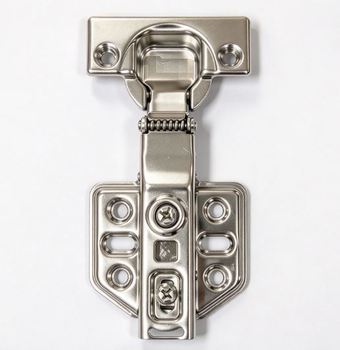
A precision-stamped cabinet hinge repair plate kit completely bypasses the stripped hole zone. By encasing the failure area with a solid stainless steel diaphragm measuring 90mm × 90mm or 90mm × 50mm, the repair bracket redistributes dynamic operational torque across 6 to 12 perimeter screw anchors placed into uncompromised virgin substrate. This dramatically reduces pounds-per-square-inch load on any single fastening point below the material's failure threshold.
Cantilever Torque Dampening Wide-Area Stress Dispersion Moisture-Decay Isolation Zero Re-Drilling Requirement